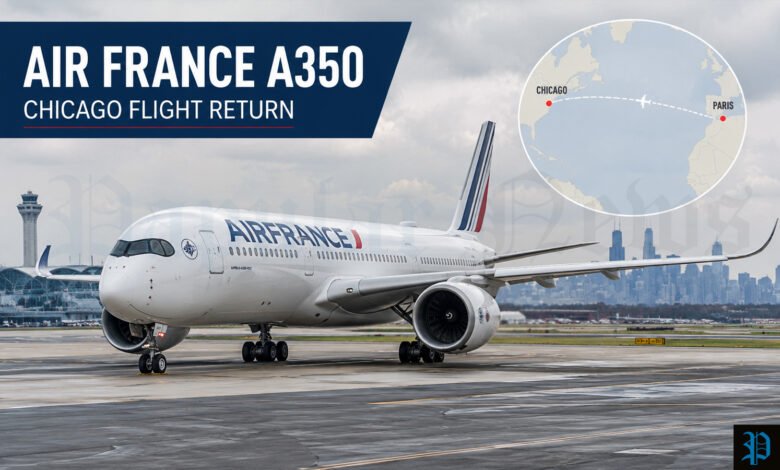
Imagine this. You get on a big plane in Paris, you eat your first meal, you watch a movie, and you look forward to landing in Chicago. Then, almost seven hours later, you land in Paris again. That is what happened to the passengers of Air France flight AF136 on June 28, 2025.
The story spread fast. Many people asked the same simple question: why did the Air France A350 Chicago flight return? In this article, we look at what is known, what is still unclear, and what it means for you if you fly this route. We keep things simple and stick to facts from aviation news reports and official information.
Quick Summary
Here are the main points before we go deeper:
- Flight AF136 left Paris Charles de Gaulle (CDG) for Chicago O’Hare (ORD) on Saturday, June 28, 2025.
- The plane was an Airbus A350-900.
- The crew turned the plane around over the Atlantic Ocean, between Iceland and Greenland, after about half of the trip.
- The plane landed safely back in Paris after 6 hours and 37 minutes in the air.
- Air France said the return was for “operational reasons” and did not give more details.
- A passenger told an aviation news desk that the flight did not get permission to land in Chicago. This has not been confirmed by the airline or by officials.
- Air France gave passengers a hotel for the night and a new flight the next day.
What Happened on Flight AF136
Let us go through the day step by step. The times below come from flight tracking data that aviation news sites reported.
The departure
Flight AF136 took off from Paris Charles de Gaulle Airport at about 12:49 in the afternoon, local time. It used runway 26R. The plane climbed to a cruising height of about 38,000 feet. It flew a northern route that goes over the United Kingdom, which is normal for flights from Paris to the Midwest of the United States.
Everything looked like a normal long flight. Passengers settled in. Nothing public suggests a problem at this stage.
The turn
At about 4:30 in the afternoon, Paris time, the crew changed course. The plane was over the North Atlantic, in the area between Iceland and Greenland. By then, it had flown roughly half of the way. Flight trackers showed the plane making a wide turn and heading back toward France.
This is the part that surprised people. A turn like this, in the middle of the ocean, does not happen often. When a plane turns back that far into a flight, the crew has usually thought about it carefully.
The landing
The plane landed at Paris Charles de Gaulle on runway 27R. The whole flight lasted 6 hours and 37 minutes. All the passengers got off the plane safely. There were no reports of injuries or of an emergency on board.
The next day
Air France arranged a hotel for the passengers for the night. It also rebooked them on a replacement flight, AF4080. This flight left Paris for Chicago on Sunday, June 29, at 14:20 local time, according to AviationA2Z. Ground staff helped the passengers at the airport.
The Plane: A Quick Look at the Airbus A350-900
To understand this story, it helps to know the plane. The Airbus A350-900 is one of the newest big planes in the sky. Air France uses it on many long routes.
Here are some facts from Air France’s own information sheet:
- The plane is about 66.8 meters long.
- The wingspan is about 64.75 meters.
- The range is about 13,000 kilometers. That is far more than the distance from Paris to Chicago.
- The cabin is wide and quiet, with bigger windows than older planes.
- The first Air France version had 324 seats: 34 in Business, 24 in Premium Economy, and 266 in Economy.
Air France has also made new cabins for some of its A350 planes. In the 2023 version, there are 48 Business seats, 32 Premium Economy seats, and 212 Economy seats. The Business seats turn into flat beds.
So, was the plane too weak or too old for this trip? No. The A350 is built for flights much longer than Paris to Chicago. The plane’s design is not the main question in this story.
The Route: Paris to Chicago
Air France has flown the Paris to Chicago route for many years. In recent years, the airline has used the A350 on it. In 2022, Air France put the A350 on the Chicago route for the summer season. Later, it kept using the plane there.
Air France also opened its first lounge at Chicago O’Hare. It is in Terminal 5. Business Traveller reported that the airline planned up to seven flights a week between Chicago and Paris in the winter season, all on the A350. This shows that Chicago is an important city for Air France.
A flight from Paris to Chicago takes a long time. The trip west is usually a little longer than the trip east, because of the strong winds high above the ocean. One traveler who flew from Chicago to Paris on a Premium Economy ticket in November 2025 reported a flight time of about 7 hours and 49 minutes.
Why Did the Plane Turn Back? What We Know
Now to the main question. The honest answer is that we do not know the full reason. Here is what is public.
What Air France said
Air France said the flight went back to Paris for “operational reasons.” That is a wide term. Airlines use it for many kinds of problems. It can mean a technical issue, a rule problem, a crew problem, or a trouble with permissions. The airline did not say more.
What a passenger said
According to AIRLIVE, a passenger said the crew did not get landing authorization at Chicago O’Hare. This is where the story got most of its attention. Many news sites repeated it, with titles like “denied landing clearance.”
Why we should be careful
This story comes from one passenger, and no official body has confirmed it. Some aviation fans on a flight tracking website also questioned it. They said that an airport control tower in Chicago does not manage a plane that is still over the middle of the Atlantic. They also said that there are other airports in North America where a plane could land if there was a problem at O’Hare. That does not mean the passenger was wrong. It means that the real story could be more complex than a short headline.
So, the safest way to say it is this: the plane returned for operational reasons, and one report says the cause was a missing landing permission.
What Does “Landing Permission” Mean?
Many people do not know that planes need approval to fly to another country. Let us explain it in simple words.
When a plane flies from Europe to the United States, a lot of paperwork happens before and during the flight. The airline files a flight plan. It shares details about the plane, the crew, and the passengers with the right authorities. The plane must also meet the rules for the airport where it wants to land.
If something in this process goes wrong, the plane may not get approval to land. It could be a small data issue, a problem with a document, or a problem with a certificate for the plane or the crew. We do not know if any of this happened on AF136. But it shows why an “operational” problem does not always mean a broken engine.
A Similar Case: American Airlines Flight AA780
Another flight in June 2025 gives us an example of how a paperwork problem can change a trip. According to AviationA2Z, American Airlines flight AA780 left Philadelphia on June 2, 2025, for Naples, Italy. The flight went to Rome instead.
The reason was not the weather. The airline had swapped the plane. The new plane, a Boeing 787-9, was not approved to land at Naples airport. The airline used another plane to fly the Naples part of the route.
This case is not the same as AF136, and we should not say the two flights had the same problem. But it shows that planes can be sent to a different place for rule reasons, not only for safety or weather reasons.
Other Reasons a Plane Can Turn Back
Since the reason for AF136 is not confirmed, it helps to know the usual reasons for a turnback. Experts say these are the main ones:
- Weather. Storms or bad weather at the destination can stop a plane from landing. Experts say weather is one of the top reasons for diverted or returned flights, especially in winter.
- Technical problems. A warning light, a system that does not work as expected, or a part that needs checking can make a crew return to a place where engineers can look at it.
- Medical emergencies. A very sick passenger or crew member may need a hospital fast.
- Security issues. A threat or a person on the plane who should not be there can make a flight return.
- Rules and paperwork. Missing approvals or certificates can stop a flight.
The aviation safety website SKYbrary explains that an air turnback is when a plane goes back to its departure airport when that was not the plan. It can happen at any stage of a flight, even when the plane is close to its destination but cannot land.
How Common Are Turnbacks?
You may think this almost never happens. In fact, it happens more often than most people believe. A flight tracking expert once said that out of about 150,000 flights on a normal day, around two dozen do not arrive where they planned, for many reasons. Most of these do not make the news because they are short flights or the return happens soon after takeoff.
What made AF136 special is the length of the trip. Flying nearly seven hours and landing where you started is rare and costly for an airline. It uses a lot of fuel, and it upsets the plans of hundreds of people. So airlines only do it when they feel they must.
Who Decides to Turn Back?
The captain has the final say in the air. But the captain does not decide alone. The crew talks with the airline’s operations center on the ground. Engineers and planners help check the options. Air traffic control gives the crew new routes and heights.
Together they ask simple questions:
- Is it safe to keep going?
- Where can we land in a safe and legal way?
- What will happen to the passengers after landing?
On an ocean flight, the options change as the plane gets farther from land. When a plane is near the middle of the ocean, going forward and going back can take the same time. The crew then chooses the place that gives the best support for the plane and for the passengers. Paris is the airline’s main base, with its own engineers, parts, and staff. That can be a strong reason to return there.
Was It Safe?
Yes, the available reports say the plane landed normally, and there were no injuries. A turnback is not a crash, and it is not a sign that the plane was in danger. In most cases, a turnback is the safety system doing its job. The crew would rather lose time and money than take a risk.
The A350 itself has a good safety name. It is a modern plane with two engines, a strong build, and many systems that check themselves. A decision to turn it back says more about a careful crew than about a weak plane.
It is also true that we do not know the full reason. So we should not say it was a small problem or a big problem. We can only say that the outcome was safe.
What Happened to the Passengers?
For the people on board, the day was long and tiring. They spent nearly seven hours in the air, and they ended up where they began. Many of them probably had connections, meetings, or family events in Chicago.
Air France did the following:
- It put the passengers in a hotel in Paris for the night.
- It rebooked them on flight AF4080 the next day.
- It had ground staff at the airport to help.
This is the kind of care that airlines are expected to give when a flight is cancelled or cannot finish. Still, a night in Paris is not what most people planned. Even with good care, a turnback is stressful.
Passenger Rights When a Flight Returns
If your flight returns to the start airport, you may have rights. These depend on where you fly from and which airline you use. This is general information and not legal advice.
The European rules
Europe has a rule called EU261. It covers flights that leave from an airport in the European Union, and flights that arrive in the EU on an EU airline. Paris is in the EU, and Air France is a European airline, so flights like AF136 are often covered by this rule.
Under EU261, passengers have the right to care when a flight is cancelled or badly delayed. Care includes:
- Meals and drinks
- A hotel, when you must stay one or more nights
- Transport between the airport and the hotel
- Two phone calls or emails
You can also choose between a refund and a new flight.
Money compensation
EU261 can also give a fixed payment of 250 to 600 euros, depending on the flight distance and how late you reach your final stop. But the airline does not have to pay if the problem was an “extraordinary circumstance,” such as very bad weather, a strike by air traffic staff, or a security threat. Even in those cases, the airline must still give you care and a refund or a new flight.
Legal experts in Europe have also said that a flight can count as cancelled when it returns to its starting airport. If you are ever in this situation, ask the airline what it considers your flight to be, and keep your papers.
What to do if it happens to you
- Stay calm and listen to the crew.
- Ask the airline staff what the plan is for food, a hotel, and a new flight.
- Keep your boarding pass, receipts, and any messages from the airline.
- Write down times: when you left, when you returned, and when you finally arrived.
- Send a claim to the airline after your trip if you think you are owed money.
Tips for Travelers on Long Flights
You cannot control a turnback. But you can make the day easier. Here are some simple tips:
- Keep important items in your carry-on. Medicine, a phone charger, a change of clothes, and your travel papers should be with you, not in your checked bag.
- Save the airline’s app and phone number. Messages about new flights often come to the app first.
- Do not book a tight connection after a long flight. If you must change planes in Chicago, leave plenty of time.
- Think about travel insurance. It can help with extra costs such as hotel or food when the airline does not cover them.
- Check your passport and visa papers before you fly. For the United States, make sure your travel approval, such as ESTA if it applies to you, is ready.
- Be kind to the crew and the ground staff. They did not choose the problem, and they are the people who can help you most.
What This Means for Air France’s Chicago Flights
One turnback does not change the whole picture. Air France still flies to Chicago, and the A350 is still the main plane on this route. The airline has been adding more for its Chicago passengers, such as its new lounge at O’Hare.
For future trips, the main lesson is about communication. When a flight goes back, passengers want to know why. The short phrase “operational reasons” leaves a gap, and that gap gets filled by guesses and rumors. Clear and honest updates help passengers trust an airline, even when the news is not good.
How to Read News About Flight Incidents
This story also shows how fast flight news can grow into something bigger than it is. After AF136, many websites posted copy-and-paste articles with dramatic titles. Some even made up details, such as a “silent flight” or a plane that was “scrapped” mid-air. These stories had no real facts behind them.
Here is how you can check a flight story:
- Look for the flight number, the date, and the route.
- Check if the story names a real source, such as flight tracking data or an airline statement.
- Look for words like “reportedly” or “according to.” They show that something is not yet confirmed.
- Be careful with titles that use fear or shock words.
- Wait for the airline or the safety agency to share the final facts.
Final Thoughts
The Air France A350 Chicago flight return was a rare event, but it ended safely. Flight AF136 flew for almost seven hours, turned back over the North Atlantic, and landed in Paris without injuries. Air France said the reason was operational and gave no more details. One passenger report said the plane did not get landing permission in Chicago, but that is not confirmed.
What we can say for sure is this: the crew chose to go back, the passengers got a hotel and a new flight, and the A350 was not shown to be unsafe. If you plan to fly this route, you do not need to worry more than usual. Just pack smart, know your rights, and keep your trip plans flexible.
If more official facts come out, the story may become clearer. Until then, it is best to rely on careful reports and not on dramatic headlines.
Frequently Asked Questions
Why did the Air France A350 Chicago flight return to Paris?
Air France said the flight returned for “operational reasons” and gave no more details. A passenger told an aviation news desk that the plane did not get permission to land at Chicago O’Hare. This has not been confirmed by the airline or by any official body, so the full reason is still unclear.
Which flight was it, and when did it happen?
It was Air France flight AF136 from Paris Charles de Gaulle to Chicago O’Hare. It took off on Saturday, June 28, 2025, at about 12:49 in the afternoon, local time. It used an Airbus A350-900.
How long was the plane in the air before it came back?
The plane was in the air for 6 hours and 37 minutes. It turned around over the North Atlantic, between Iceland and Greenland, after flying about half of the way to Chicago.
Was anyone hurt on the flight?
No injuries were reported. The plane landed safely on runway 27R at Paris Charles de Gaulle, and the passengers left the aircraft normally.
What did Air France do for the passengers?
Air France arranged a hotel in Paris for the night and rebooked the passengers on a replacement flight, AF4080. That flight left for Chicago on Sunday, June 29, and ground staff helped passengers at the airport.
Is the Airbus A350 a safe plane?
Yes. The A350 is a modern plane with two engines and strong safety systems, and it is built for flights much longer than Paris to Chicago. A turnback does not show that a plane is unsafe. It shows that the crew chose a careful path.
Why would a plane fly so far and then turn around?
Crews decide based on safety, rules, and the best place to get help. If a problem comes up or if the plane cannot get the right approval, the crew may decide that going back to the home base is the best choice. Paris is the main base for Air France, with engineers and parts ready.
Can passengers get money when a flight returns to the start airport?
It depends on the flight and the cause. Under the European rule EU261, passengers can get care such as meals and a hotel. They may also get 250 to 600 euros if the airline is at fault, but not if the cause was an extraordinary circumstance, such as severe weather. Ask the airline and keep your papers. This is general information, not legal advice.
How often do flights turn back in the middle of a trip?
It happens more often than most people think, but a turnback after many hours over the ocean is rare. Common reasons are bad weather, technical problems, medical emergencies, and security or paperwork issues. Most turnbacks happen soon after takeoff and get little news attention.
Does Air France still fly the A350 from Paris to Chicago?
Yes. The A350 is the main plane Air France uses on the Paris to Chicago route. Air France has also opened its first lounge at Chicago O’Hare, in Terminal 5, and planned up to seven weekly flights on the route in the winter season.
MORE INFORMATION STAY CONNECT FOR : PAPULAR NEWS