

If you typed “BrandRank.ai normalization transformation rules” into Google, you probably expected to find a clear rulebook. Instead, you found many articles that look almost the same, and most of them don’t agree with each other. That can feel confusing, so let’s slow down and sort it out together.
In this guide, I’ll explain what BrandRank.AI really does, what “normalization” and “transformation” mean in plain words, and how these ideas connect to tracking a brand inside AI answers. I’ll also be honest about what is confirmed and what is not. You don’t need a data science background. If you can follow a recipe, you can follow this article.
Quick Summary
Here are the main points before we go deeper:
- BrandRank.AI is a real company. It sells software that shows how brands appear in answers from AI tools like ChatGPT, Gemini, and Perplexity.
- Normalization and transformation are real, common steps in data work. They clean and reshape messy data so it can be compared fairly.
- We could not find a public document from BrandRank.AI that is named “normalization transformation rules.” Many blog posts use the phrase, but they don’t point to an official source.
- The phrase is still useful as a way to talk about how any AI visibility tool should prepare its data.
- The real, named parts of BrandRank.AI’s public material are its Brand Health and Trust framework, its three main metrics, and a tool called BRAND ANSWER.
Now let’s look at each piece slowly.
What Is BrandRank.AI?
BrandRank.AI is a business software company based in Cincinnati, Ohio. It offers a SaaS platform. SaaS just means you use the tool online and pay a subscription, like you would with many work apps.
The tool helps brands see how they show up in AI answer engines. These are tools where people ask a question and get a written answer, not a list of links. Think of someone asking, “What is a good running shoe for flat feet?” The AI gives a short answer and may name a few brands. If your brand is not in that answer, or if the answer says something wrong about you, you want to know.
In its launch news in May 2025, the company said it focuses on three main areas:
- AI search visibility. How often and how clearly your brand appears in AI answers.
- AI vulnerability. Where your brand could be shown in a wrong, weak, or risky way.
- Content readiness. How ready your own content is to be picked up and used by AI tools.
One of the co-founders, Hank Hudepohl, described the platform as a “GPS for brands” across AI search. That is a nice way to picture it. A GPS doesn’t drive for you, but it shows where you are and where you could go next.
The company has also grown in the news. It announced a seed funding round of about three million dollars, and it was named a Representative Vendor in the 2026 Gartner Market Guide for Answer Engine Visibility Tools. Its CEO, Pete Blackshaw, has also announced a book called The Answer Economy, planned with Wiley for September 2026.
The company says it tests brand prompts across many AI engines, and it has named tools such as ChatGPT, Gemini, Perplexity, Claude, Grok, and DeepSeek in its public material.
Is There an Official “Normalization Transformation Rules” Document?
This is the part most articles skip, so let’s be direct.
After checking the public website, press releases, and news about the company, there is no page that defines a product feature or a rulebook called “BrandRank.ai normalization transformation rules.” Several independent articles that looked into the same question reached the same result. One of them says that many near-identical posts appeared within a few weeks and none of them link to anything BrandRank.AI published under that name. Another careful write-up calls the phrase a practical way to describe data handling, not a published technical spec.
So where did the phrase come from? It seems to come from people searching for it and from writers who joined two real ideas together:
- BrandRank.AI, a real AI brand tracking tool.
- Normalization and transformation, real steps in how data is prepared.
That doesn’t make the topic useless. A tool that tracks thousands of AI answers must handle messy data in some way. It just means we should not pretend we can see the company’s private formulas. Nobody outside the company can, unless the company shares them.
In this article, I’ll treat “normalization transformation rules” as a general idea. I’ll explain how this kind of work is usually done in AI visibility tracking, and I’ll clearly say when something is a general example and not a confirmed BrandRank.AI method.
What Does Normalization Mean?
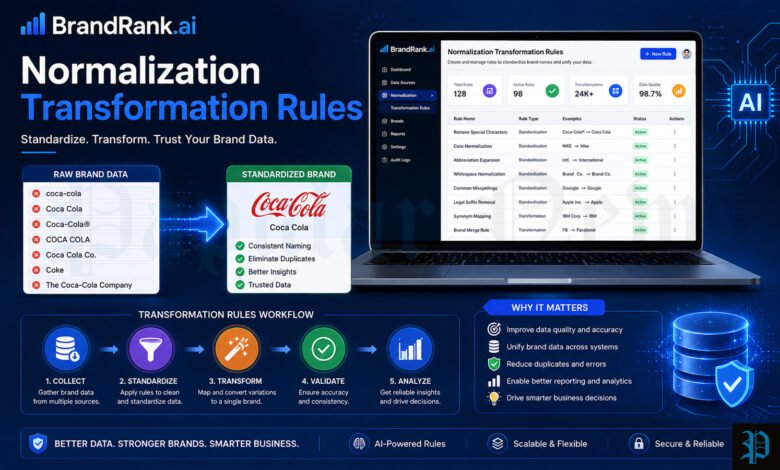
Normalization means taking data that looks different and making it look the same, so it can be counted or compared.
Here is a simple, everyday example. Imagine you ask ten friends for their favorite phone brand. You get these answers:
- “Apple”
- “apple”
- “Apple Inc.”
- “iPhone”
- “Apple, Inc”
A person can see that these all point to the same company. A computer can’t, unless you teach it. If you count these as five different things, your report will be wrong. Normalization fixes this by turning all five into one clean label, such as “Apple.”
In data work, the word “normalization” is used in two common ways:
- Text and name cleaning. Making names, spellings, and formats consistent. This is what the example above shows.
- Number scaling. Changing numbers so they fit on a similar scale, for example from 0 to 1, so different kinds of scores can be compared.
Both meanings matter for brand tracking, and we will look at both below.
What Does Transformation Mean?
Transformation is the bigger step. It means reshaping data from one form into another form that is more useful.
Normalization is one kind of transformation, but not the only kind. Transformation can also include:
- Splitting one long AI answer into smaller parts.
- Pulling out the brand names it mentions.
- Marking whether each mention is positive, neutral, or negative.
- Listing which websites the AI used as sources.
- Turning all of that into rows and columns in a table.
Think of a raw AI answer as a messy kitchen after cooking. Normalization is wiping the counters and putting things in the right jars. Transformation is the whole process of turning the raw food into a finished meal that is ready to serve.
Normalization vs. Transformation at a Glance
| Step | Main goal | Simple example |
|---|---|---|
| Normalization | Make similar things look the same | “Brand Rank AI” and “brandrank.ai” become one name |
| Transformation | Change data into a more useful shape | An AI paragraph becomes a row with brand, sentiment, and source |
If it helps, remember this: normalization makes things match, and transformation makes things usable.
Why These Steps Matter for AI Brand Tracking
AI answers are not like search results. A normal search result page has fixed slots, links, and positions. An AI answer is free text, and it can change from one moment to the next. Two people can ask almost the same question and get different words.
That creates a few real problems for any tool that wants to measure a brand:
- Names appear in many forms. A brand might be written with spaces, with a dot, in capital letters, or with a short nickname.
- Answers vary. The same question may give a slightly different answer each day.
- Different AI tools behave differently. One tool may name five brands, and another may name two.
- Raw numbers can mislead. A brand that is mentioned 500 times in a huge test set may look strong, but a smaller brand mentioned 50 times in a tiny test set may actually be doing better.
Without cleaning and fair scaling, the final report could say something that isn’t true. A brand team might then spend money fixing a problem that doesn’t exist, or miss one that does.
There is also a trust angle. A report from Burke, a research company, notes that many people still worry about how accurate and fair AI answers are. One figure quoted in news about the partnership says 47 percent of consumers have concerns about accuracy and objectivity. Another article about the topic mentions that 58 percent of users say AI is changing how they find and judge brands. If people rely on these answers, then measuring them carefully matters.
Common Normalization Rules in Practice
Since there is no public BrandRank.AI rulebook, here are the kinds of rules that most serious AI visibility tools would need. Treat these as general examples. They are not a copy of anyone’s private system.
Rule: Make brand names consistent
The first job is to decide on one official name for each brand, often called a canonical name. Then every spelling variation is matched to it.
For example:
- “BrandRank AI”
- “Brand Rank”
- “brandrank.ai”
All of these would point to one record named “BrandRank.AI.” This process is often called entity resolution. It is not the same as a spell check. A spell check fixes typing mistakes. Entity resolution decides that two different-looking pieces of text mean the same real thing.
Rule: Handle capital letters and punctuation
Computers see “Nike” and “nike” as different words unless told otherwise. A common rule is to change text to lowercase for matching, but keep the original text for display. Extra spaces, dashes, and dots are also cleaned up during matching.
Rule: Remove company endings when matching
Words like “Inc.,” “Ltd.,” “LLC,” and “Corp.” matter in legal papers, but they usually don’t matter when an AI mentions a brand in a friendly answer. Many data systems ignore these endings when matching names, so “Acme Corp” and “Acme” are treated as one brand.
Rule: Match web addresses to brands
Sources often show up as web addresses. The same page might be listed with a “www” in one place and without it in another. Rules can remove the “www,” ignore tracking codes at the end of a link, and group pages under the main site.
Rule: Link products to parent brands
If an AI mentions a product name, the tool may need to know which company owns it. A mention of a specific shoe model should count toward the shoe company, while still being tracked as its own product.
Rule: Merge duplicates, but be careful
Sometimes the same source or the same answer is saved twice. Rules can remove exact copies so they don’t count double. The risk is on the other side: merging two brands that only look alike. For example, two companies might have almost the same name in different countries. Good systems add checks, like location or industry, before merging.
Rule: Keep the original text
This one is easy to forget. A careful system keeps the raw text next to the cleaned version. If a rule turns out to be wrong later, the team can go back, fix it, and run the numbers again. Keeping a record of which rule version was used is also a good habit.
Common Transformation Rules in Practice
After the cleaning step, the data is reshaped. Here are common examples.
Rule: Turn answers into mentions
An AI answer is split into pieces, and each brand name found in it becomes one “mention” record. The record might include the question asked, the AI tool used, the date, and the position of the brand in the answer.
Rule: Turn sources into citations
If the AI tool shows where its information came from, each source is saved as a citation. Over time, a team can see which websites keep shaping how AI talks about their brand.
Rule: Mark sentiment
A mention can be labeled positive, neutral, or negative. This is not always simple, because a sentence can be mixed. Many teams use a small number of clear labels or a score from low to high.
Rule: Mark competitors
When two or more brands appear in the same answer, the tool can record which ones were named together and in what order. This lets a team compare itself with rivals.
Rule: Group questions by topic
Hundreds of test questions are easier to read when grouped. A food brand might group questions into “price,” “health,” “taste,” and “where to buy.” Then the results can be shown by topic.
Scaling Methods: The Number Side of Normalization
Now let’s look at the second meaning of normalization, which is about numbers. Scores often come in different sizes. One score might be a percent from 0 to 100. Another might be a count from 0 to 5,000. If you add them together without fixing the sizes, the big numbers will overpower the small ones.
Here are three popular ways to scale numbers. These are standard methods used across data science, and they are not tied to one company.
Min-max scaling
This method squeezes values into a range from 0 to 1. The formula is:
new value = (value - smallest value) / (largest value - smallest value)
If your scores run from 20 to 80 and one brand scores 50, its new value is (50 – 20) / (80 – 20), which is 0.5. This works well when numbers have a clear lower and upper limit, such as review scores. It can be thrown off by one very high or very low value.
Z-score scaling
This method tells you how far a value is from the average, measured in steps called standard deviations. The formula is:
new value = (value - average) / standard deviation
A result of 0 means the value is exactly average. A result of 2 means it is well above average. This is useful when you want to compare scores that came from different tests.
Log scaling
When numbers grow very fast, like mentions that go from 10 to 10,000, a log scale makes the gap smaller and easier to read. It stops a few huge values from hiding everything else.
A good habit, which is common in data science, is to work out the scaling numbers from a training set first, and then apply them to new data. This avoids letting information from the future leak into the past. Also, scaling is normally done before combining different datasets, so one dataset doesn’t unfairly dominate the final score.
A Simple Walk-Through Example
Let’s put the ideas together with a small made-up example. A tea company wants to know how it shows up in AI answers about “best green tea for beginners.”
Step 1: Collect. The team asks the same question to three AI tools and saves the three answers.
Step 2: Clean names. One answer says “GreenLeaf Tea Co.” Another says “Greenleaf.” The third says “greenleaf.com.” The rules match all three to a single brand called “GreenLeaf.”
Step 3: Pull out facts. For each answer, the team records whether GreenLeaf was named, its position (first, second, or later), the tone of the sentence, and any website shown as a source.
Step 4: Scale scores. The team has a “mention count” and a “tone score.” Because these use different scales, they are both brought to a 0 to 1 range.
Step 5: Combine and compare. The team builds one simple visibility score and compares it with two rival brands.
Step 6: Act. The report shows GreenLeaf is named often but is never linked to “good for beginners.” That tells the content team what to write next.
This is a general example to show the flow. A real platform will have more checks, more questions, and many more brands.
What BrandRank.AI Publicly Offers Today
To keep this article honest, let’s list only what the company has said publicly.
- A web-based platform that runs recurring tests of brand prompts across major AI answer engines.
- Reports on AI search visibility, vulnerability, and content readiness.
- Benchmarking against competitors.
- A framework it calls Brand Health and Trust.
- A diagnostic called BRAND ANSWER, built with Burke, Inc. and announced in May 2026. It is described as a way to see how AI answers portray a brand, where the brand is missing from key consumer questions, and how it compares with competitors.
- Burke’s brand strategy framework, called Relevance + Momentum, is planned to help ground the numbers in real human behavior.
The company also reports work in food, nutrition, and health, including a partnership with S2B Group around a tool for tracking AI influence on recommendations in those areas.
None of this material says “normalization transformation rules,” and the company hasn’t shared its exact scoring weights in public. If you need those details, the best step is to ask the company directly.
Common Mistakes to Avoid
If you’re writing about this topic, or using these ideas in your own work, watch out for these problems.
- Treating blog posts as proof. Many pages repeat each other. Always look for a first-hand source, like the company website or a press release.
- Claiming secret formulas. Don’t state exact weights or steps unless the company has shared them.
- Over-cleaning. If you remove too much from a name, two different brands might look the same.
- Throwing away raw data. Always keep the original text so you can fix mistakes later.
- Mixing scales. Don’t add a 0 to 100 score to a count in the thousands without scaling first.
- Testing too few questions. AI answers change. A small test can give a false picture.
- Forgetting to update rules. Brands change names, websites move, and products are renamed. Rules need regular checks.
How Brands Can Use These Ideas Today
You don’t need special software to start. Even a small team can improve how AI tools see and describe its brand by following a few simple habits.
- Pick one official brand name and use it everywhere. Use the same spelling on your website, social pages, press pages, and business listings. Consistency helps both people and AI systems understand that all these pages talk about one company.
- Write a clear “about” page. State who you are, what you sell, and where you operate, in plain words.
- Keep product names steady. If you rename a product, explain the change on your site so old and new names stay connected.
- Use structured data on your website. Markup that describes your organization and products helps machines read the facts correctly.
- Check your key facts often. Address, founding date, pricing, and key features should match across your pages.
- Ask AI tools about your brand. Try questions your customers might ask. Write down what comes back and look for mistakes or missing information.
- Track changes over time. Run the same questions each month and save the results in a simple sheet.
These steps won’t give you a perfect score, but they reduce confusion, and confusion is what normalization rules are built to fix.
Final Thoughts
“BrandRank.ai normalization transformation rules” is a phrase that took off online, but it isn’t a published rulebook from the company. What is real is BrandRank.AI itself, the way it measures brand visibility, vulnerability, and content readiness in AI answers, and the general data steps that any such tool needs: cleaning names, reshaping answers into useful records, and scaling scores so they can be compared fairly.
If you remember only one thing, let it be this: normalization makes similar things match, and transformation makes raw data useful. When you read any article about this keyword, ask where the claim comes from. If there’s no clear source, treat it with care.
I hope this guide made the topic easier to understand. If you have a brand of your own, start with the small habits above. They cost little and they help.
Frequently Asked Questions
What are BrandRank.ai normalization transformation rules?
It’s a phrase used online to describe how brand data is cleaned and reshaped before it is scored. It is not a named, published rulebook from BrandRank.AI. It’s best understood as a general description of data preparation in AI visibility tracking.
Is BrandRank.AI a real company?
Yes. It’s a software company based in Cincinnati, Ohio. It offers an online platform that tracks how brands appear in AI answer engines, and it has announced funding, partnerships, and a product launch in public news.
What does normalization mean in simple words?
It means making similar things look the same. For example, “Apple,” “apple,” and “Apple Inc.” can all be turned into one clean label so a computer counts them as one brand. It can also mean scaling numbers to a common range.
What does transformation mean in data work?
Transformation means changing data into a shape that is easier to use. A long AI answer might be turned into a table row that lists the brand, the tone, the source, and the date. Normalization is one part of this larger process.
What is the difference between normalization and transformation?
Normalization focuses on consistency, so that matching items look alike. Transformation is wider and includes any change that makes data more useful, such as splitting text, adding labels, or building new fields. Most data teams do both.
What does BrandRank.AI actually measure?
Its public material names three main areas: AI search visibility, AI vulnerability, and content readiness. It also talks about benchmarking against competitors and about trust in how a brand is described.
What is BRAND ANSWER?
BRAND ANSWER is a diagnostic tool announced in May 2026 through a partnership between BrandRank.AI and Burke, Inc. It is described as a way to see how AI answers portray a brand, where a brand is missing from important consumer questions, and how it compares with rivals.
Why do AI brand tools need to clean their data?
AI answers are written in free text, and brand names show up in many forms. Without cleaning, one brand could be counted several times, or two different brands could be mixed up. Clean data leads to fairer and more reliable reports.
Which scaling methods are common for scores?
Three common ones are min-max scaling, z-score scaling, and log scaling. Min-max puts values between 0 and 1. Z-score shows how far a value is from the average. Log scaling shrinks very large gaps so results are easier to read. These are standard methods and are not unique to one company.
How can a small business improve how AI describes its brand?
Start with simple steps. Use the same brand name everywhere, write a clear about page, keep product names and facts consistent, add structured data to your website, and test common customer questions in AI tools every month. Keep notes so you can see progress over time.
MORE INFORMATION STAY CONNECT FOR : PAPULAR NEWS


